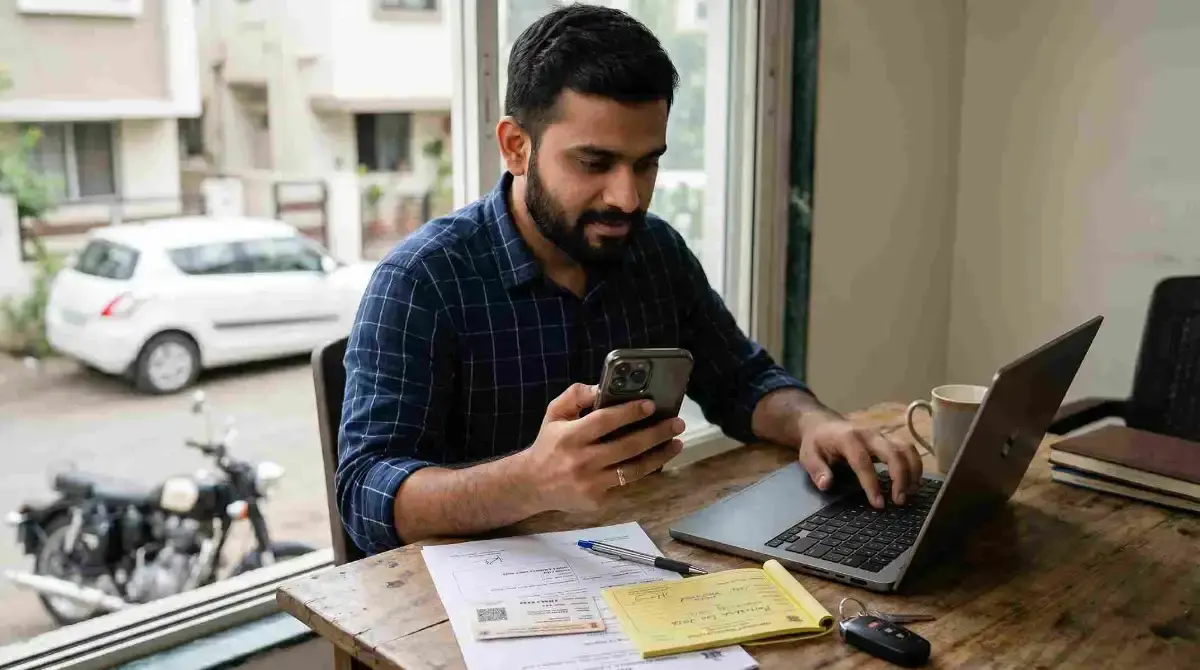

Pay road tax on Parivahan portal in minutes. Step-by-step guide for 2026: MV tax, green tax on old vehicles, BH-series, state-wise rates & receipt download.
"Parivahan Tax refers to paying Motor Vehicle (MV) Tax on the official government portal at vahan.parivahan.gov.in. Enter your vehicle registration number, verify via OTP, and pay using UPI, net banking, or debit card — the whole process takes under 10 minutes from any browser or the mParivahan app.
Free Indian tax & finance calculators at toolisky.com
Parivahan is the unified transport services platform run by the Ministry of Road Transport and Highways (MoRTH). When people search "parivahan tax," they mean the vehicle tax payment service embedded inside this portal — specifically the VAHAN module at vahan.parivahan.gov.in.
Motor Vehicle Tax (commonly called road tax) is levied under the Motor Vehicles Act, 1988. It is a state subject — so each state sets its own rates, but the Parivahan portal provides a central payment gateway that works across states. Think of it as one login to pay tax no matter which state your vehicle is registered in.
The portal handles three distinct tax scenarios most people encounter:
New vehicle road tax — one-time lifetime tax paid at registration (15-year validity for private vehicles)
Commercial vehicle MV tax — paid quarterly, half-yearly, or annually depending on state
Green tax — applicable when renewing registration of vehicles older than 15 years (private) or 8 years (commercial)
Note: checkpost border tax — the inter-state transit tax — is a separate service at checkpost.parivahan.gov.in. We have covered that separately. This article focuses on VAHAN road tax, which is what the vast majority of car and bike owners need.
The process is the same for most states. Chrome on desktop or the mParivahan app both work fine. Have your vehicle registration number and the last 5 digits of your chassis number ready before you start.
Go to the VAHAN citizen services portal
Open vahan.parivahan.gov.in/vahanservice in your browser. Bookmark the official URL — there are several unofficial lookalike sites.
Enter your vehicle registration number
Type it in the format shown — e.g., MH12AB1234. Select your state from the dropdown and click Proceed.
Select "Online Services" → "Pay Vehicle Tax"
The dashboard shows all services available for your vehicle. Click Pay Vehicle Tax specifically — not "Pay Fee" which handles RC-related services.
Enter chassis number & validate
Type the last 5 characters of your chassis number (found on RC or under the bonnet on a VIN plate) and click "Validate Regn_no/Chasi_no." This confirms vehicle ownership before payment.
Generate OTP & verify mobile
An OTP is sent to the mobile number registered with the RTO. If your number is not updated, do that first via parivahan.gov.in → "Update Mobile Number in Vahan/Sarathi" — it's free and doesn't require an RTO visit.
Select tax mode & pay
For commercial vehicles, choose Quarterly, Half-Yearly, or Yearly. Private vehicles will show the lifetime tax amount. Click Generate Tax, confirm the amount, then choose UPI, Net Banking, or Debit Card. Avoid Credit Cards — some states don't support them on this gateway.
Download your receipt immediately
On successful payment, the portal generates a tax receipt in PDF. Download it on the spot — this serves as proof at traffic checkposts until your RC is updated. You can also re-download it later via the same portal.
Tip: If you're paying via UPI, keep your app open in a different tab before clicking Pay. The portal's payment gateway timeout is short — around 5 minutes — and a session timeout is the most common reason for a "failed" transaction that was actually deducted.
Green tax (formally the Environmental Compensation Tax under the Motor Vehicles Act framework) is the charge you pay when renewing registration on an ageing vehicle. The logic is deliberate: make holding an old, polluting vehicle cost more than switching to a cleaner one. It's not a money-grab; it's a behaviour nudge.
Private vehicles
Petrol/diesel cars & two-wheelers older than 15 years from original registration date. Paid at fitness certificate renewal — every 5 years after the 15-year mark.
Commercial vehicles
Buses, trucks, taxis older than 8 years. Paid annually with regular MV tax renewal via the VAHAN portal.
[VERIFY: Confirm current rates on your state's transport department portal before relying on these — rates change with state budgets. The table below is compiled from published state notifications as of June 2026.]
State | Private Car (15+ yrs) | Two-Wheeler (15+ yrs) | Commercial (8+ yrs) | EV Exempt? |
|---|---|---|---|---|
Maharashtra | Doubled from Apr 2026 (≈ 50% of road tax) | 25% of road tax | 10–15% of road tax | Yes |
Delhi | Up to 50% (diesel >10 yrs: banned by NGT) | Up to 50% | Up to 50% | Yes |
Tamil Nadu | ₹2,500 fixed | ₹500 fixed | 10–15% of road tax | Yes (100%) |
Karnataka | 10–25% of road tax | 10% | 10–15% | Partial (tiered) |
Uttar Pradesh | 10–15% of road tax | 10% | 10% | Yes |
Kerala | 15–25% of road tax | 10% | 10–15% | Partial (tiered) |
Rajasthan | 10% of road tax | 10% | 10% | Yes |
Source: State transport department notifications compiled June 2026. Verify on your state's portal before paying.
Here's what competitor articles typically skip: if you scrap your old vehicle at a government-registered Registered Vehicle Scrapping Facility (RVSF), you get a Certificate of Deposit (CoD). That certificate entitles you to a 15–25% road tax reduction on your next new vehicle purchase in most states — plus, Maharashtra specifically offers a 30% concession on motor vehicle tax when scrapping a BS-III or older vehicle. So the maths of "pay green tax vs. scrap and buy new" is often tighter than it looks.
CNG, LPG, EV, ethanol, and strong hybrid vehicles are exempt from green tax in most states. Mild hybrids that only do start-stop (like many 48V systems) usually do not qualify. When in doubt, check the fuel type listed on your RC — that's what the RTO system reads.
The Bharat (BH) Series registration, introduced in 2021 under Rule 47A of the Central Motor Vehicles Rules, is a national registration that removes the hassle of re-registering your car every time you move states for work. Road tax under BH series is paid in 2-year blocks via the VAHAN portal — not as a one-time 15-year payment.
Fuel Type | BH-Series Tax Rate (per 2 years) | Calculated On |
|---|---|---|
Petrol | 8–12% of invoice price | Ex-showroom (including GST) |
Diesel | 10–14% of invoice price | Ex-showroom (including GST) |
Electric (EV) | 6–10% of invoice price | Ex-showroom (including GST) |
Who is eligible? Central and state government employees, defence personnel, and private-sector employees of companies with offices in 4 or more states (or UTs). You renew every 2 years through the VAHAN portal using the same OTP-based flow described in Section 2 above.
Common misconception: BH-series does not mean zero road tax. You still pay — just in smaller, portable instalments. For a ₹12 lakh petrol car, the 2-year BH tax works out to roughly ₹96,000–₹1,44,000 over 15 years (depending on which band applies). Compare that to a one-time lifetime tax in your state before deciding which route is cheaper for you.
Pramod buys a Maruti Swift petrol with an ex-showroom price of ₹8,00,000 in Pune, registered in June 2026.
Component | Amount |
|---|---|
Road tax (Maharashtra petrol, ₹5–10L slab: 11%) | ₹88,000 |
Registration fee (fixed nationwide) | ₹600 |
HSRP number plate | ₹400 |
FASTag (mandatory) | ₹600 |
Total RTO cost (excluding insurance) | ₹89,600 |
[VERIFY: Maharashtra's exact road tax slab percentage for ₹5–10L petrol cars — confirm on the Maharashtra Transport Department portal before publishing.]
Pramod pays the road tax portion (₹88,000) directly on the VAHAN portal at the time of registration. The dealer handles this for new vehicles, but understanding the breakup lets Pramod verify he wasn't overcharged.
Sunita owns a diesel sedan registered in 2010 in Bangalore (Karnataka). In 2026, she renews its registration for another 5 years. The original road tax she paid in 2010 was ₹60,000.
Component | Amount |
|---|---|
Green tax (Karnataka diesel car, 25% of original road tax) | ₹15,000 |
Fitness certificate renewal fee | ₹1,000 (approx) |
PUC certificate (valid PUC mandatory before renewal) | ₹80–200 |
Total to pay on Parivahan this renewal | ≈ ₹16,200 |
Sunita pays the green tax component on the VAHAN portal. The fitness certificate is handled separately at a designated vehicle testing station (not on the portal). Both must be done before the RC renewal is approved.
If Sunita scraps this vehicle instead, she receives a Certificate of Deposit from an RVSF, which gives her a ₹9,000–₹15,000 road tax reduction on a new car in Karnataka. Over a ₹10 lakh new car purchase, this can offset more than half the green tax she would have paid.
Rates below are for new petrol private cars based on ex-showroom price. [VERIFY: Cross-check with parivahan.gov.in or the respective state transport portals before publishing — EV exemption policies in particular change frequently.]
State | Rate (Petrol) | EV Road Tax | Calculated On |
|---|---|---|---|
Dadra & Nagar Haveli | 2.5–3% | Exempt | Ex-showroom (pre-GST) |
Gujarat | 6% | 1% nominal | Ex-showroom (pre-GST) |
Delhi | 4–12.5% (slabs) | Exempt | Ex-showroom |
Maharashtra | 7–11% (slabs) | Exempt | Ex-showroom |
Karnataka | 13–18% (slabs) | Tiered | Ex-showroom |
Telangana | 13–21% + ₹5,000 cess | Exempt | Ex-showroom |
Tamil Nadu | 10–14% (slabs) | Exempt (100%) | Ex-showroom |
Rajasthan | 4–10% (slabs) | Exempt | Ex-showroom |
Madhya Pradesh | 8–14% (slabs) | Exemption expired Mar 2026 | Ex-showroom |
Source: Compiled from state transport portal notifications, motomotar.com (April 2026), and paybima.com (February 2026). Verify before relying on specific rates.
Not sure which tax regime saves you more as a salaried person?
If your employer deducts TDS on salary, your income tax choice matters as much as your vehicle tax. Use our free calculator to compare old vs new regime in seconds.
Old vs New Tax Regime Calculator →
This is the section most guides skip entirely. Payment failures on vahan.parivahan.gov.in are common — especially during peak times (month-ends, after new vehicle launch surges). Here's what actually works:
! Step 1: Do not pay again immediately
Check your bank statement or UPI app first. If the amount was debited, wait 48–72 hours. Most failed transactions auto-reconcile, and the receipt appears in your VAHAN account automatically.
! Step 2: Use the "Recheck Transaction" option
On the checkpost.parivahan.gov.in portal (yes, the checkpost portal handles VAHAN transaction disputes too), there's a "Recheck the fail transaction" option. Enter your vehicle number and transaction ID from your bank statement. The system re-queries the payment gateway and updates the status.
→ Step 3: SMS fallback (for some states)
Send VAHAN [STATE CODE] CP [VEHICLE NO] to 7738299899. This works for checkpost-linked transactions. For regular VAHAN tax, contact the helpdesk number listed in the portal footer for your state.
✕ Never select the wrong service and pay
The portal explicitly warns: if you select the wrong service and pay, the amount is not refunded or adjusted. Double-check the service name before hitting the payment button — particularly "Pay Vehicle Tax" vs. "Pay Fee" (for RC-related filings).
Verify your vehicle's registration number format before entering it on the VAHAN portal.
Old vs New Tax Regime Calculator
Calculate your take-home salary including all deductions for FY 2025–26.
Short-Term Capital Gains Tax Calculator
Selling a vehicle or other asset? Check your STCG liability for FY 2025–26.
Section 87A Marginal Relief Calculator
Income just above ₹12L? Section 87A marginal relief may reduce your income tax to near zero.
Planning a vehicle purchase in 2026?
Your vehicle's on-road price includes road tax that varies by up to 3× depending on which state you register in. Use our vehicle number format checker to confirm your current registration details are accurate before switching states.
Vehicle Number Format Checker →
Go to vahan.parivahan.gov.in, enter your vehicle registration number, click Online Services → Pay Vehicle Tax, enter the last 5 digits of your chassis number, verify via OTP sent to your registered mobile, select the tax period, pay via UPI or net banking, and download your receipt. The full process takes 5–10 minutes.
Green tax is an additional environmental levy on private vehicles older than 15 years and commercial vehicles older than 8 years. It is paid when renewing the fitness certificate, not separately. Maharashtra doubled its green tax in April 2026 to approximately 50% of the original road tax. Delhi charges up to 50% and Tamil Nadu charges a flat ₹2,500 for cars. EV, CNG, and LPG vehicles are exempt in most states.
For private cars and two-wheelers, road tax is a one-time lifetime payment valid for 15 years. No annual renewal is needed. Commercial vehicles pay quarterly or annually through the VAHAN portal. BH-series vehicles pay in 2-year blocks that renew on parivahan.gov.in.
The receipt downloads automatically after a successful payment. To re-download later, visit vahan.parivahan.gov.in, enter your vehicle number, select the transaction history section, and print or save the PDF. Keep this receipt accessible on your phone — traffic authorities accept a digital copy during checkpost inspections.
Go to parivahan.gov.in and use the "Update Mobile Number in Vahan/Sarathi" option. This is a free, self-service update that does not require an RTO visit. You'll need your vehicle registration number and to verify via Aadhaar-linked OTP or a one-time RTO-authorised process depending on your state.
BH-series (Bharat Series) registration lets transferable government and private-sector employees pay road tax in 2-year renewable blocks instead of a one-time 15-year payment. The renewal happens on vahan.parivahan.gov.in using the same OTP-based payment flow. Rates are 8–12% (petrol), 10–14% (diesel), and 6–10% (EV) of the invoice price per 2 years.
Under the Motor Vehicles Act, 1988 and the 2019 Amendment, driving with lapsed road tax can result in fines, vehicle detention at checkposts, and legal action. For commercial vehicles, expired tax also invalidates permits and can void insurance claims. Keep your receipt accessible and always renew commercial vehicle tax before the due date.
Do not pay again. Wait 48–72 hours for auto-reconciliation. If the receipt still doesn't appear, use the "Recheck Failed Transaction" option on the checkpost.parivahan.gov.in portal with your vehicle number and bank transaction ID. Alternatively, contact the state helpdesk listed in the portal footer with your transaction reference number.
Ministry of Road Transport and Highways (MoRTH) — parivahan.gov.in — Official VAHAN and Sarathi services portal
VAHAN Citizen Services — vahan.parivahan.gov.in/vahanservice — Direct link for vehicle tax payment
Motor Vehicles Act, 1988 (as amended 2019) — Section 39 and related tax provisions
Central Motor Vehicles Rules — Rule 47A (BH-series registration)
Maharashtra Motor Vehicles Tax (Amendment) Act, 2026 — Green tax revision (April 2026)
Vehicle Scrappage Policy 2021 — Ministry of Road Transport and Highways notification
State transport portals: Maharashtra RTO, Karnataka Transport Dept., Tamil Nadu Transport Dept. — for state-specific tax rates
Disclaimer: This article is for educational purposes only. Vehicle tax rates, green tax slabs, and portal processes change with state budgets and MoRTH notifications. Always verify current rates on parivahan.gov.in or your state's transport department portal before making any payment. For vehicle purchase decisions or tax planning, consult a qualified professional. See our Accuracy & Limitations policy.
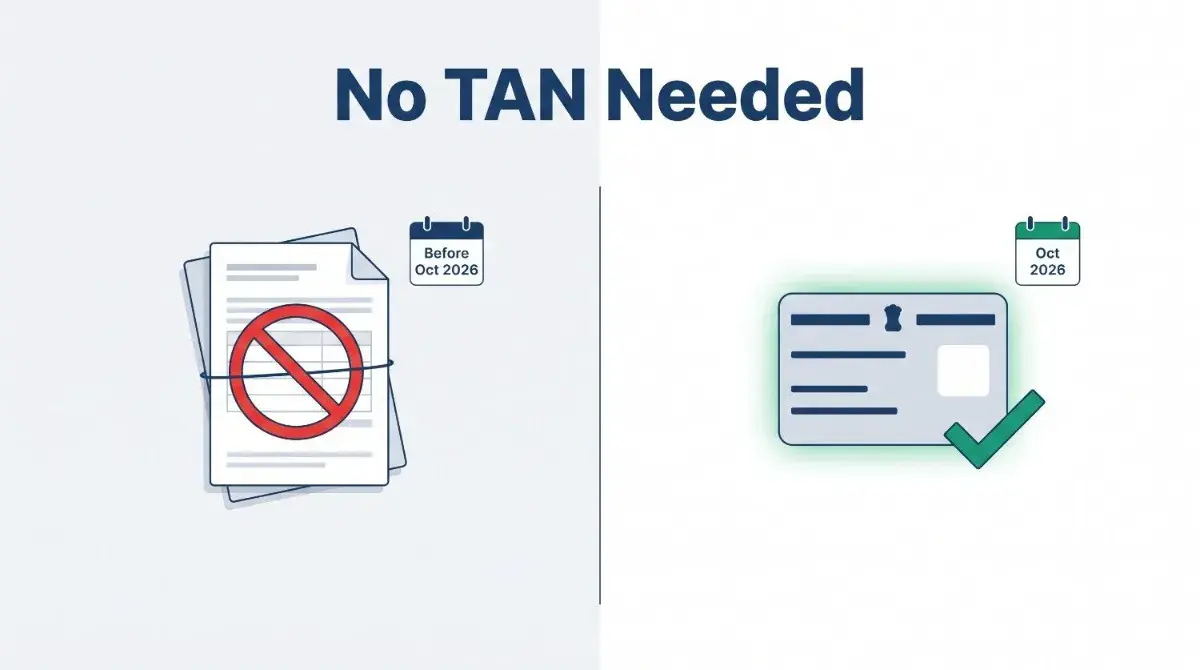
No TAN for NRI property purchase applies only from 1 October 2026, and only to resident individual and HUF buyers. Get the rates, forms, and dates you need.
Jul 25, 2026

Did you lose the SGB premature redemption tax exemption? Here's exactly who's affected, how much tax applies now, and how to check your own bonds.
Jul 24, 2026
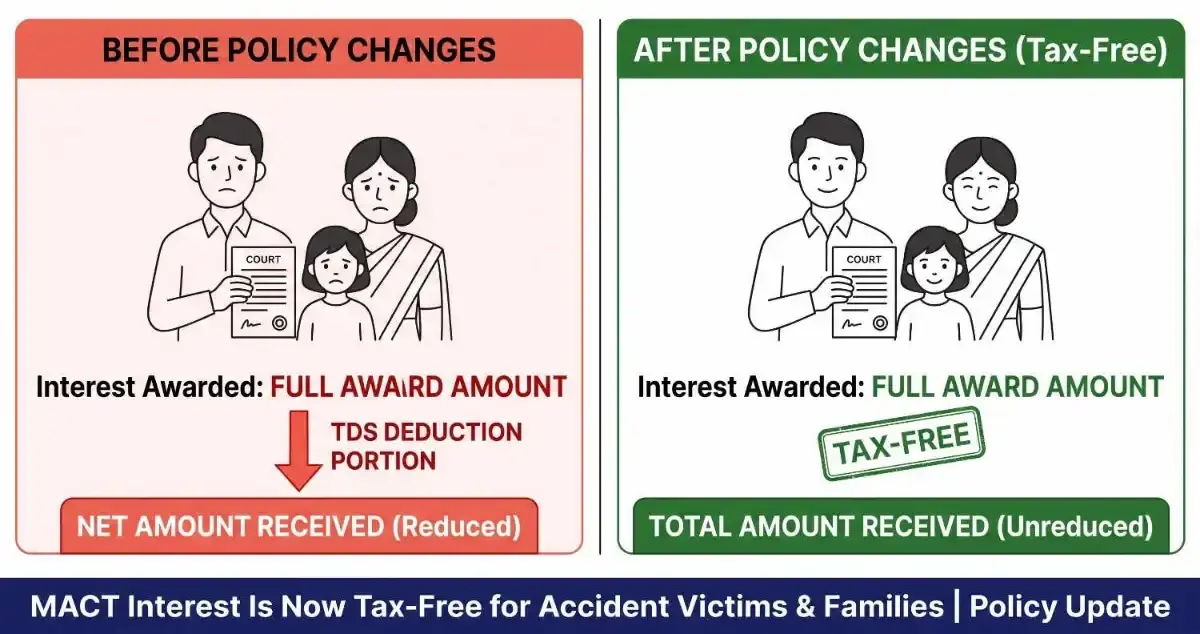
MACT interest income TDS exemption 2026 explained: who qualifies, old vs new Act rules, the FD interest trap, refund steps, and how to report it in your ITR.
Jul 24, 2026