
Filing for AY 2026-27 but paying advance tax for Tax Year 2026-27? Get the exact dates, portal tabs, and penalty rules before you file — in plain English.
If you've felt lost this year switching between "AY 2026-27" and "Tax Year 2026-27" on the income tax portal, you're not alone. Two tax laws are technically live at once right now, and each one uses its own labels for the same money.
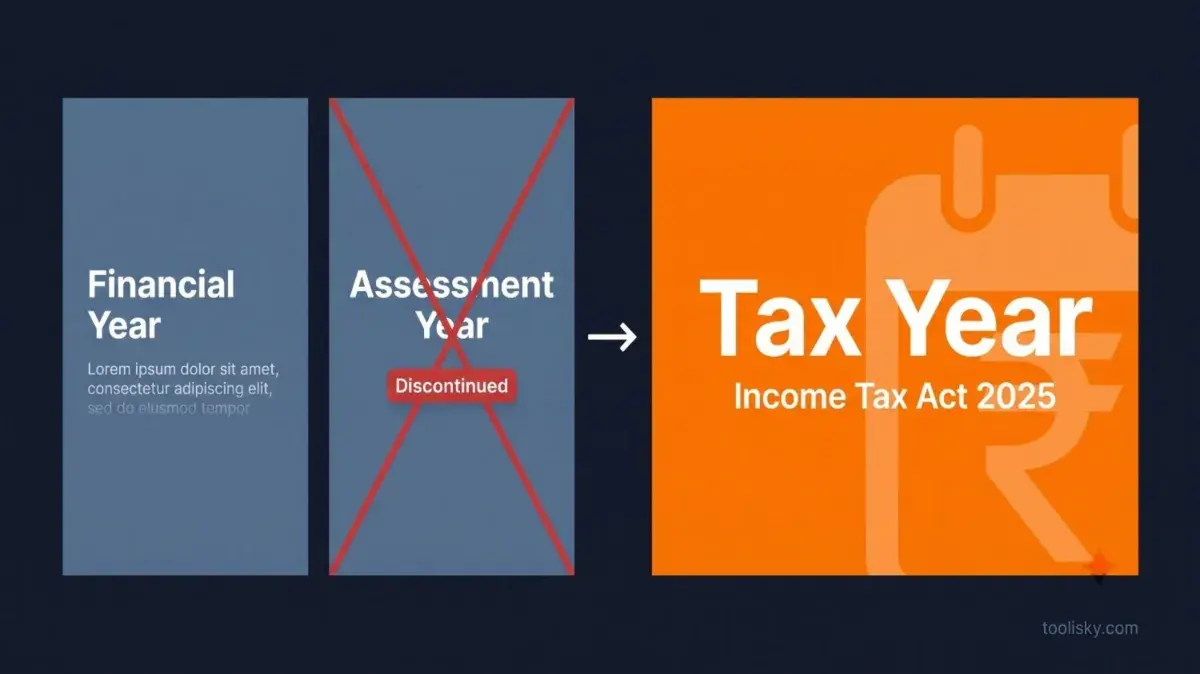
Here's the short version: Financial Year is when you earn the income. Assessment Year, under the old 1961 law, is the year after that, when the income gets taxed. Tax Year is the new law's way of collapsing both into one label, starting 1 April 2026.
This guide walks through the Tax Year vs Assessment Year question in plain terms, so you pick the right tab, the right form, and the right deadline this filing season.
Financial Year (FY) is simply the 12 months from 1 April to 31 March, the period in which you actually earn your money. That part hasn't changed and isn't going anywhere.
Assessment Year (AY) is the year that comes right after the Financial Year, the year in which that income gets assessed and taxed under the old Income-tax Act, 1961. So income you earned in FY 2025-26 gets assessed in AY 2026-27.
Tax Year is the new term. Under Section 3 of the Income Tax Act, 2025, a tax year is simply the 12-month period of the financial year that begins on 1 April, and it takes over from the old "previous year" label used in the 1961 Act. The change kicks in from 1 April 2026, for income earned in FY 2026-27 onward, which the new law calls Tax Year 2026-27. There's no separate "Assessment Year 2027-28" hiding anywhere; that concept simply doesn't exist under the new Act.
So why the mix-up this July? Because income you earned in FY 2025-26 is still governed by the old 1961 Act and gets assessed as AY 2026-27, while anything you earn from 1 April 2026 onward falls under the new 2025 Act and is called Tax Year 2026-27. Both labels are live on the income tax portal at the same time this year, which is exactly why they get confused.
Applies to | Does NOT apply to |
|---|---|
Anyone filing an FY 2025-26 ITR (uses AY 2026-27, old Act) | Income earned before FY 2020-21 (already closed and assessed) |
Anyone paying advance tax for Tax Year 2026-27 from June 2026 | Old court disputes pending before 1 April 2026 (old Act continues) |
Salaried employees, freelancers, and businesses filing this season | — |
NRIs with assessments that span both years | — |
Payroll teams and CAs updating their software | — |
There's one partial exception worth knowing: if a search under Section 132 started before 1 April 2026, every proceeding connected to it keeps running under the old 1961 Act, no matter how long it takes to wrap up.
The legal basis. Section 3 of the Income Tax Act, 2025 defines the tax year. Section 536, the repeal-and-savings clause, keeps both laws running side by side without any gap in coverage. Under Section 536(3), wherever the new Act mentions a tax year for a period before 1 April 2026, you read that as the matching "previous year" under the old Act. This is only a reading rule; it doesn't change how income from those earlier years is actually taxed.
Just how big is the rewrite? The new Act runs to 536 sections and 16 schedules, down from 819 sections and 14 schedules in the 1961 Act. The accompanying rules have shrunk too, from 511 rules and 399 forms down to 333 rules and 190 forms. That's why so many section numbers have moved around this year.
Key renumbered sections you'll actually run into:
Old (1961 Act) | New (2025 Act) | What it covers |
|---|---|---|
Section 115BAC | Section 202 | New tax regime (still the default) |
Sections 44AD, 44ADA, 44AE | Section 58 | Presumptive taxation, now one consolidated section |
Section 192 | Section 392 | TDS on salary |
Sections 194A–194T (60+ sections) | Section 393 | Non-salary TDS, now in consolidated tables |
Section 44AB | Section 63 | Tax audit applicability |
Year-by-year conversion, so you can check any year at a glance:
Financial Year | Governing law | Old-style label | New-style label | ITR due date |
|---|---|---|---|---|
2020-21 to 2024-25 | 1961 Act | AY 2021-22 to AY 2025-26 | N/A | Closed |
2025-26 | 1961 Act | AY 2026-27 | N/A | 31 July / 31 Aug 2026 |
2026-27 | 2025 Act | N/A | Tax Year 2026-27 | 31 July 2027 (expected) |
2027-28 | 2025 Act | N/A | Tax Year 2027-28 | 31 July 2028 (expected) |
ITR filing deadlines for AY 2026-27 (this season, still under the old Act): 31 July 2026 for salaried taxpayers and investors filing ITR-1 or ITR-2. 31 August 2026 for non-audit business and professional taxpayers filing ITR-3 or ITR-4, a permanent change under the Finance Act 2026, not a one-time extension. 31 October 2026 for audit cases, stretching to 30 November 2026 where transfer-pricing reporting under Section 92E applies. Miss the original date, and a belated return is still possible up to 31 December 2026, while the window for a revised return has been pushed out to 31 March 2027.
Form names that changed, not their content. Form 16 becomes Form 130, and Form 26AS becomes Form 168, the new "Tax Passbook," but only from Tax Year 2026-27 onward, so your FY 2025-26 paperwork keeps the familiar old names this year. Form 15G and Form 15H merge into one Form 121. Form 15CA becomes Form 145 and Form 15CB becomes Form 146, worth remembering if you handle NRI remittances.
Priya, salaried, filing this July. Priya earned ₹9,60,000 in FY 2025-26, and her Form 16 shows ₹62,000 in TDS. Because this income falls before 1 April 2026, she files under the old Act and quotes AY 2026-27, not "Tax Year 2025-26." Her deadline is 31 July 2026. Miss it, and Section 234F adds a ₹5,000 fee since her income is above ₹5 lakh, plus 1% monthly interest under Section 234A.
Suresh, paying advance tax mid-year. Suresh expects around ₹8,00,000 in profit between April and June 2026. That income falls under the new Act, so he selects the "Income Tax Act 2025" tab and pays it as Tax Year 2026-27, not AY 2027-28, which doesn't exist. His first instalment, 15% of an estimated ₹1,20,000 annual tax bill, works out to ₹18,000, due 15 June 2026, on a completely different tab from any leftover AY 2026-27 self-assessment tax he still owes.
The e-filing portal now shows a simple radio-button choice: pick "Income Tax Act 1961" for anything relating to Assessment Years up to and including AY 2026-27, and pick "Income Tax Act 2025" for anything relating to Tax Year 2026-27 onward. The same split shows up when you're viewing forms too, with the portal separating "Forms as per Income Tax Act 2025" from "Forms as per Income Tax Act 1961."
Here's how to get it right in practice:
Log in at incometax.gov.in with your PAN.
For your FY 2025-26 return, go to e-File → Income Tax Returns → File Income Tax Return, and choose AY 2026-27 under the Income Tax Act 1961 tab.
For any Tax Year 2026-27 advance tax payment, go to e-Pay Tax and select "Income Tax Act 2025" before you pick your challan.
Before you submit anything, check that the acknowledgment label matches the tab you picked, not whatever year is in your head.
You picked AY 2026-27 for income that actually belongs to Tax Year 2026-27. The payment lands against the wrong period. Contact the CPC helpline straight away and ask for a challan correction rather than waiting for it to surface later at assessment.
You quoted "Assessment Year 2027-28" out of old habit. That label simply doesn't exist under the new Act, and using it will likely trigger a manual-review flag and a delayed refund. File a rectification request the moment you spot the mistake.
Your TDS certificate still carries the old form name. Nothing's wrong here. Form 26AS keeps its name for income earned before 1 April 2026; Form 168 only comes into play once you're filing Tax Year 2026-27 returns in 2027. No fix needed.
Document | Digital copy OK? | Where to get it |
|---|---|---|
Form 16 (FY 2025-26, still under the old name) | Yes | Your employer, by 15 June 2026 |
Form 26AS / AIS | Yes | incometax.gov.in e-filing portal |
Advance tax challan (Tax Year 2026-27, new Act tab) | Yes | e-Pay Tax section, portal |
PAN and Aadhaar | Yes | UIDAI / income tax portal |
Bank statements for TDS reconciliation | Yes | Net banking |
Using the wrong label doesn't invent a brand-new penalty on its own, but it does make existing ones worse. Miss the AY 2026-27 deadline, and Section 234F kicks in: ₹1,000 if your total income is ₹5 lakh or below, ₹5,000 if it's higher, plus 1% monthly interest under Section 234A. Under-paying advance tax for Tax Year 2026-27 draws interest under the shortfall rules carried over from Sections 234B and 234C. A wrong-tab filing can also trigger a defective-return notice under Section 139(9), which gives you a fixed window to refile before the return counts as never having been filed at all.
No. AY 2026-27 covers your FY 2025-26 income under the old 1961 Act. Tax Year 2026-27 covers income earned from 1 April 2026 under the new 2025 Act. They happen to share a number, but not a period.
For your FY 2025-26 return, use the "Income Tax Act 1961" tab and select AY 2026-27. Only switch to the "Income Tax Act 2025" tab when you're paying advance tax on income earned after 1 April 2026.
To end a two-year system that confused filers for decades, one year for earning the money, another for filing on it. The Tax Year concept folds both into a single label.
From 1 April 2026 to 31 March 2027, the same window the old Financial Year 2026-27 would have covered. Your accounting period itself doesn't change.
No. Your employer still issues Form 16 under that familiar name for FY 2025-26. Form 130 only applies to salary paid from Tax Year 2026-27 onward.
Claims for years before April 2026 stay under the old Act's terms. Only income from Tax Year 2026-27 onward uses the new labels and renumbered forms, like Form 145 and Form 146.
Your tax year begins on the date you set up the business and runs until 31 March of that financial year. So a business started on 1 December 2026 gets a tax year of just four months.
No. It's purely a reading rule that tells you how to interpret old references inside the new text. It doesn't alter the tax treatment that applied to those earlier years.
File a rectification or revised return as soon as you notice. Under the Finance Act 2026, the revised return window now runs to 31 March 2027, giving you more room than before.
Yes, eventually. Any system generating Form 16, Form 26AS, or TDS challans will need the new form numbers and the new portal tab once you start processing Tax Year 2026-27 transactions.
Yes. Most countries tax and assess income in the same period. The UK runs a single tax year from 6 April to 5 April, the US uses the calendar year, and Australia runs 1 July to 30 June. The 2025 Act brings India's system closer to that global norm.
Check every return or payment against one simple question: does this income fall before or after 1 April 2026? That single answer decides your tab, your form numbers, and your deadline. For the exact ITR form to use this season, see our guide on new ITR forms for AY 2026-27. And for the law itself, always trust the Income Tax Department's e-filing portal over any blog post, including this one.
For educational purposes only. Please verify all figures at official sources before acting on them. Toolisky is not affiliated with any government body. Consult a qualified CA or legal professional before making compliance decisions. See toolisky.com/accuracy-and-limitations.
No TAN for NRI property purchase applies only from 1 October 2026, and only to resident individual and HUF buyers. Get the rates, forms, and dates you need.
Jul 25, 2026

Did you lose the SGB premature redemption tax exemption? Here's exactly who's affected, how much tax applies now, and how to check your own bonds.
Jul 24, 2026
MACT interest income TDS exemption 2026 explained: who qualifies, old vs new Act rules, the FD interest trap, refund steps, and how to report it in your ITR.
Jul 24, 2026