
Section 44AD lock-in penalty explained: the 5-year re-entry bar, when Section 44AB audit kicks in, and the real ₹ cost of exiting early in FY 2025-26.
There's no cash fine written into the law for opting out of Section 44AD. What you actually get is a 5-year ban on re-entering the scheme, and sometimes a compulsory tax audit the same year. That combination is what people really mean when they search for the Section 44AD lock-in penalty, so let's separate the two clearly and look at when each one applies.
Section 44AD of the Income-tax Act, 1961 lets small businesses declare 6% or 8% of turnover as taxable profit, so they can skip detailed books and audits. For income earned up to FY 2025-26 (assessed in AY 2026-27), this is still the law that applies. From Tax Year 2026-27 onward, business, professional, and transport presumptive schemes get merged into one section — Section 58 of the Income-tax Act, 2025 — and the same lock-in carries forward under Section 58(7).
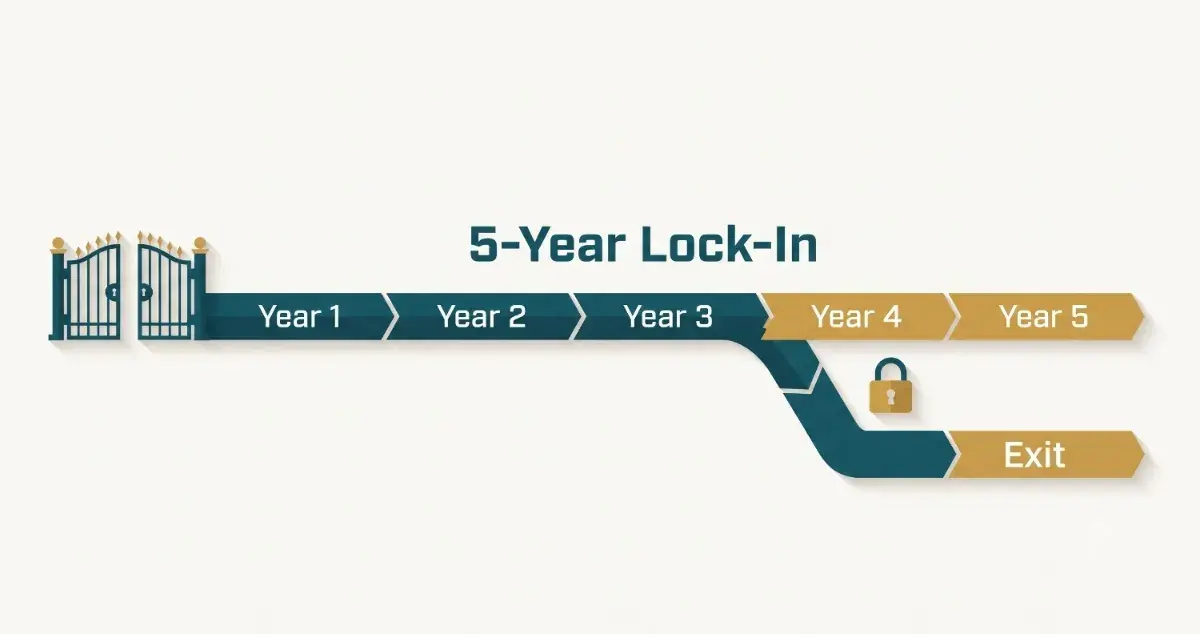
Here's the bit most articles skip over: the Section 44AD lock-in penalty isn't really a penalty in the sense of a fine. It's a disqualification. Opt out early, and you simply can't come back to presumptive taxation for five straight assessment years. Whether you also end up paying money depends on a second, separate trigger, which we'll get to below.
The official text of Section 44AD(4) puts it this way: once you've declared profit in line with the scheme for a year, and then declare profit "not in accordance with" it in any of the following five years, you lose the benefit of the section for five assessment years after that. [Source: incometaxindia.gov.in]
Applies to | Does NOT apply to |
|---|---|
Resident individuals, HUFs, and partnership firms who used 44AD and then declared profit below the deemed rate | LLPs and companies — these were never eligible for 44AD to begin with |
Anyone who used 44AD for at least one year, then switched to actual-books filing showing lower profit | Businesses that never opted into 44AD in the first place |
Traders staying under the turnover cap but choosing to report real, lower profit instead of the deemed 6%/8% | Section 44ADA professionals — there's no matching 5-year lock-in written into that section (more on this below) |
Businesses whose turnover later falls back within limits, after already triggering the lock-in once | Businesses that cross the turnover limit and become ineligible purely on that ground — a genuinely different situation, explained in the examples |
Read that last row twice. Becoming ineligible because turnover crossed ₹2 crore (or ₹3 crore with 95%+ digital receipts) is not the same event as choosing to opt out. One triggers the five-year bar. The other doesn't.
Here's how the mechanism actually plays out, step by step:
You opt for 44AD in any assessment year, declaring profit at 8% of turnover, or 6% if 95% or more of your receipts are digital, under Section 44AD(1).
You later declare profit below the deemed rate in any of the next five assessment years, while you're still otherwise eligible for the scheme.
Section 44AD(4) kicks in: you can't use 44AD again for the five assessment years right after the year you broke the pattern. [Source: incometaxindia.gov.in]
If your total income in any of those locked-out years crosses the basic exemption limit — ₹4,00,000 under the new tax regime for FY 2025-26 — Section 44AD(5), read with Section 44AB(e), makes a tax audit compulsory for that particular year. [Source: incometaxindia.gov.in]
The turnover limit to even qualify for 44AD is ₹2 crore, or ₹3 crore where cash receipts and cash payments each stay under 5% of the total. Miss either 5% condition and the higher limit simply doesn't apply to you. [Source: incometaxindia.gov.in]
Under the Income-tax Act, 2025 (from Tax Year 2026-27), the same lock-in sits in Section 58(7), and the audit trigger moves to Section 63, which replaces Section 44AB with the same thresholds. [VERIFY: the exact cross-reference between Section 58(7) and Section 63 for a lock-in that's already in progress hasn't been spelled out in a CBDT circular yet — confirm at incometaxindia.gov.in before relying on this for a live filing decision.]
Example 1 — the common case. Ramesh runs a hardware trading business in Nashik. He opted into Section 44AD from FY 2021-22 (AY 2022-23) and kept declaring 8% profit every year since. In FY 2025-26, his turnover is ₹95,00,000. His actual, audited profit margin is only about 4.7%, so his CA suggests filing real books instead of the deemed 8%.
Deemed profit at 8% would have been ₹95,00,000 × 8% = ₹7,60,000. He declares his real profit of ₹4,50,000 instead — well below the deemed rate. That's exactly what Section 44AD(4) is triggered by: Ramesh can't use 44AD again for AY 2027-28 through AY 2031-32. This is a real, working example of the Section 44AD lock-in penalty in action.
His total income of ₹4,50,000 also crosses the ₹4,00,000 basic exemption limit for FY 2025-26. So Section 44AB(e) makes a tax audit compulsory for FY 2025-26 itself, with the audit report due by 30 September 2026.
Example 2 — the edge case most guides skip. Farida runs a small garments manufacturing unit. She opted into 44AD in FY 2023-24, on a turnover of ₹1,80,00,000, comfortably under the ₹2 crore cap. In FY 2024-25, her turnover jumps to ₹3,20,00,000 — above even the enhanced ₹3 crore digital-receipts limit. She's now ineligible for 44AD, but purely because of turnover, not because she chose to declare lower profit.
Does the five-year lock-in still apply to her? No. Section 44AD(4) only fires when someone who's still eligible chooses to declare profit below the deemed rate. Farida never had that choice — she became ineligible on turnover alone. So there's no lock-in bar here. If her turnover drops back within the limit later, she can opt back into 44AD the very next year she qualifies.
There isn't one clean formula for this — it's really a five-year, year-by-year comparison:
Deemed profit each year = Turnover × 6% (digital receipts) or 8% (non-digital)
Actual profit each year = Turnover × your real profit margin
Tax on each path = slab tax for that income, minus the Section 87A rebate, plus 4% cess
Add an audit fee for any year your actual income crosses the basic exemption limit
Total exit cost = (tax + audit fees under the actual-books path) minus (tax under the presumptive path), added up across all five locked-out years
Doing this by hand across five years, with turnover growth factored in, gets tedious pretty fast. If you'd rather not do it manually, our Section 44AD Exit Cost Calculator runs exactly this projection — just enter your turnover, real margin, and expected growth rate, and it totals the five-year gap for you.
You already filed ITR-3 with lower profit, without realising the lock-in would apply. You can't undo a filed return, but you can plan ahead from here. Note down the exact assessment year you become eligible again, and avoid filing under 44AD before then — doing so risks a defective-return notice.
You missed the tax audit deadline after the lock-in triggered an audit requirement. File the audit report as soon as you can, even late. A late report still limits your penalty exposure far more than never filing at all. It's also worth checking whether Section 273B's "reasonable cause" defence applies to your case — illness, a natural calamity, or lost records are commonly accepted, though none of this is automatic, and you'll need proof.
You're not sure whether your exit was turnover-driven or profit-driven. Pull your last three years of ITR computation sheets and check: did turnover cross the cap in the year you exited, or did turnover stay within limits while declared profit dropped below 6%/8%? That difference (see Example 2 above) decides whether the lock-in applies to you at all. You can also run your numbers through our Section 44AB Tax Audit Applicability Checker to confirm where you stand on the audit side.
The lock-in itself doesn't cost you anything directly — it's a restriction, not a fine. The real money exposure comes from two places:
Missing or skipping the tax audit under Section 44AB(e): the penalty under Section 271B is 0.5% of turnover, capped at ₹1,50,000, whichever is lower. On Ramesh's ₹95,00,000 turnover from Example 1, that works out to ₹47,500 if he skips the audit without a reasonable cause. [Source: incometaxindia.gov.in]
No separate penalty for the lock-in restriction itself — you just lose access to the 6%/8% presumptive rates and have to maintain proper books under Section 44AA for the barred years.
[VERIFY: whether Section 271B gets a new section number under the Income-tax Act, 2025. Budget 2026 has floated reclassifying this charge from a "penalty" to a "fee," but the final section number under the new Act hasn't been confirmed by a CBDT notification yet. Check incometaxindia.gov.in before citing a new number.]
This is one of the most searched confusions on this topic, and most articles answer it vaguely. Here's the direct point: Section 44AD(4), the 5-year lock-in, applies specifically to Section 44AD for businesses. There's no matching sub-section under Section 44ADA for specified professionals that mirrors this lock-in.
That doesn't mean professionals get off completely free. If someone under 44ADA declares profit below the 50% deemed rate, and their total income crosses the exemption limit, the audit trigger under Section 44AB(d) still applies for that year, just like the business case, only without the five-year re-entry ban. If you're weighing this exact choice, our guide on Section 44ADA eligibility and the new Section 58 rules covers the professional side in full.
You lose eligibility to use Section 44AD again for the next 5 assessment years, counting from the year immediately after you declared profit below the deemed rate. If your total income that year is above the basic exemption limit, you'll also need a tax audit for that specific year.
Not directly. The Section 44AD lock-in penalty is a restriction on scheme eligibility, not a cash fine. A monetary penalty only comes in separately, under Section 271B, and only if you're required to get audited and fail to do so, or file the audit report late.
Yes, there's no minimum number of years you must stay before you're allowed to opt out. But opting out before completing 5 consecutive years still triggers the same five-year lock-in, whether you exit in year 2 or year 4.
No. If you become ineligible purely because turnover crossed ₹2 crore (or ₹3 crore with 95%+ digital receipts), that's a genuine ineligibility, not a voluntary exit. Section 44AD(4) doesn't apply here, so no five-year bar follows.
You become eligible again from the assessment year right after the lock-out period ends, as long as you still meet the turnover and business-type conditions at that time. There's no separate application to file — you simply go back to filing ITR-4 in the eligible year.
No. The five-year re-entry bar under Section 44AD(4) is specific to business income under Section 44AD. Section 44ADA for professionals has no directly matching lock-in sub-section, though the audit trigger for under-declared profit still applies on its own.
The lock-in is tied to what you actually declared in a filed return, not to an intention. If you never filed under 44AD in the first place, sub-section (4) has nothing to trigger against, since there's no earlier year where profit was declared "in accordance with" the scheme.
No, a fresh five-year period doesn't stack on top. You're already ineligible during those years, so there's nothing new to opt out of. The original five-year window from your first exit keeps running as is.
The trigger looks at what was actually declared in the return you filed, not your intent. If you filed at a lower rate by mistake, you can revise the return before the applicable deadline. Once it's revised to match the correct deemed rate, the lock-in shouldn't apply for that year. If the original return has already been processed, it's worth talking to a CA about rectification options.
Most practitioner commentary treats it as continuous, since Section 58 largely carries the old 44AD framework forward rather than replacing its substance. [VERIFY: CBDT hasn't issued an explicit transitional clarification confirming this continuity for an in-progress lock-in — check incometaxindia.gov.in for updates before relying on this for a live filing decision.]
This confusion probably comes from the fact that Section 44AD(4) itself was introduced by the Finance Act, 2016, effective from AY 2017-18, not from any base-year rule written into the section. The statutory text ties the lock-in to whichever assessment year you actually opt out in, with no separate reference to AY 2017-18 as a starting point. [VERIFY: this specific point with a CA if your opt-in history goes back before AY 2017-18, since documented case law on this exact scenario is thin.]
Check whether your last profit declaration fell below the deemed 6%/8% rate while your turnover was still within the limit — that's the real trigger for the Section 44AD lock-in penalty, not turnover alone. Run your numbers through the Section 44AD Exit Cost Calculator before deciding to exit this year. For the official provision text, see Section 44AD on the Income Tax Department's website, and the department's utility mapping the 1961 Act to the 2025 Act for the new-Act section numbers.
For educational purposes only. Verify all figures at official sources before acting. Toolisky is not affiliated with any government body. Consult a qualified CA or legal professional before making compliance decisions. See toolisky.com/accuracy-and-limitations.

Border tax payment 2026: pay checkpost tax on Parivahan, fix a pending or failed transaction, verify your receipt, and check state-specific rates.
Aug 31, 2026

Section 87A proviso explained: first proviso rebate limits vs the second proviso's capital-gains bar, with FY 2025-26 math and real fixes for demand notices.
Aug 19, 2026

Section 87A rebate on lottery income is not allowed under Section 115BB, even below ₹12 lakh. See exact FY 2025-26 tax math, rules, and TDS rate details.
Aug 12, 2026