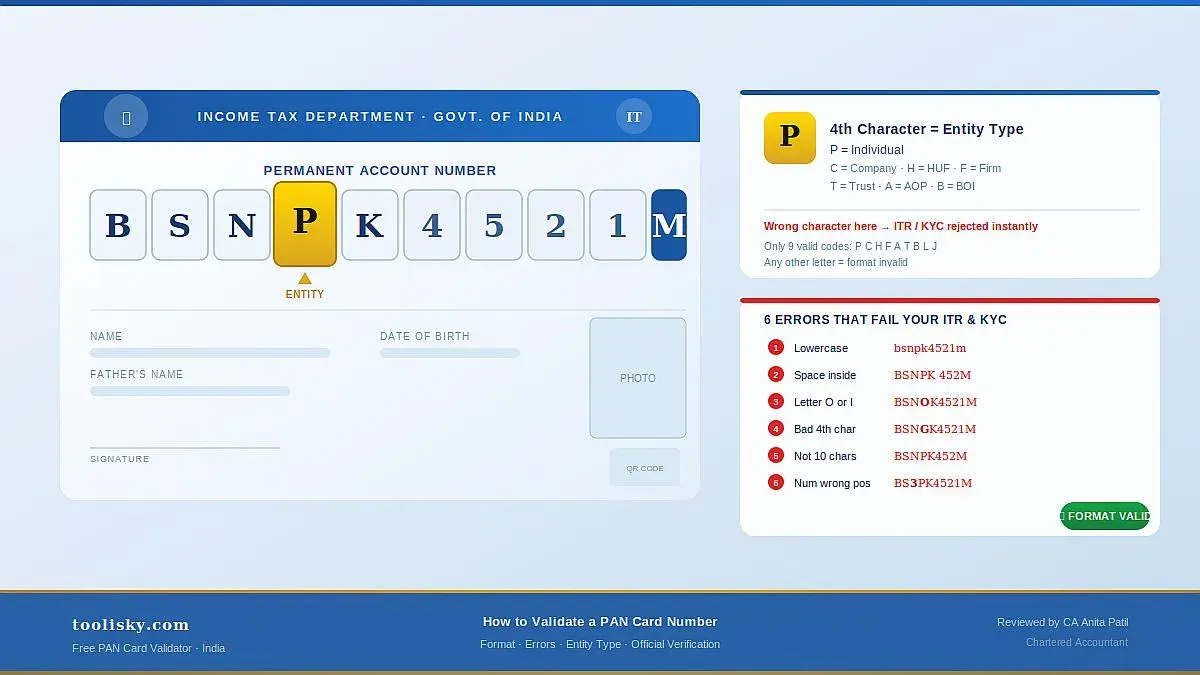

Validate a PAN card number in seconds. Check the 10-character format, spot all 6 common errors, and know when to officially verify. Free online checker.
A wrong PAN format gets your ITR rejected, your bank KYC failed, and your TDS certificate bounced. The fix takes two seconds. Every valid PAN follows a strict 10-character structure — and checking it doesn't require an internet connection, an account, or a government portal. Here's the complete breakdown.
PAN — Permanent Account Number — validation is an offline format check. It answers one question: does this PAN string follow the correct 10-character structure (AAAAA9999A) defined by CBDT (Central Board of Direct Taxes)?
Validation doesn't confirm the PAN exists in any database. It only confirms the structure is correct. You can run it without any internet. It's the first step — not the last.
Under Section 262 of the Income-tax Act, 2025 (corresponding to Section 139A of the Income-tax Act, 1961 for income and transactions up to FY 2025-26), CBDT defines the format rules that every issued PAN must follow. The format hasn't changed between Acts — but the section number has.
Applies to | Does NOT apply to |
|---|---|
Anyone filing an ITR in India | Non-residents with no Indian income or tax obligation |
Employers processing TDS on salary | Individuals below exemption limit with no transactions above ₹50,000 |
Businesses receiving vendor or freelancer PANs | Foreign entities with no Indian PAN |
NBFCs, banks, and KYC-regulated entities | Aadhaar-only substitute filers (rare CBDT-notified exceptions) |
Freelancers checking client PAN before raising invoice | — |
A note on conditional cases: if you receive a PAN from a third party — a new vendor, contractor, or employee — format validation is your first filter. But depending on the purpose, you may need official verification too. See the decision table further below.
Take the PAN RAJPK7890L. Most people have never stopped to read what their own PAN is actually telling them. Here it is, position by position.
Positions 1–3 (RAJ): The alphabetic series prefix. CBDT assigns this block systematically to prevent duplication. For individuals, it's loosely derived from the applicant's name. It's not random.
Position 4 (P): The entity type code. This one character identifies what kind of taxpayer holds the PAN. According to incometaxindia.gov.in, the 10 valid codes are:
Code | Entity Type |
|---|---|
P | Individual |
C | Company |
H | Hindu Undivided Family (HUF) |
F | Firm / Limited Liability Partnership |
A | Association of Persons (AoP) |
T | Trust |
B | Body of Individuals (BOI) |
L | Local Authority |
J | Artificial Juridical Person |
G | Government Agency |
Any other letter at position 4 — D, E, I, K, M, N, O, Q, R, S, U, V, W, X, Y, or Z — makes the PAN structurally invalid, no matter how correct every other character is.
[VERIFY: incometaxindia.gov.in explicitly lists G (Government Agency) as a valid entity code. The current Toolisky PAN validator marks G as invalid. Confirm whether G-series PANs are publicly issued to government agencies or restricted to internal CBDT allotment — and update the Toolisky tool if needed. Source: https://www.incometaxindia.gov.in/w/how-pan-is-formed-and-how-it-gets-its-unique-identity-]
Position 5 (K): For individuals, this is the first letter of the surname. The holder of RAJPK7890L has a surname beginning with K. For non-individual entities — companies, trusts, firms — this is the first letter of the entity's registered name.
Positions 6–9 (7890): A four-digit sequential number running from 0001 to 9999. Once 9999 is reached, the alphabetic prefix in positions 1–3 rolls over.
Position 10 (L): The check digit. It's a single letter algorithmically assigned by CBDT's system to validate the preceding nine characters. You can't calculate it yourself — the system generates it.
Competitors use these words interchangeably. They're not the same thing — and confusing them is how people waste time on the wrong step.
Validation | Verification | |
|---|---|---|
What it checks | Format structure only | Existence in CBDT/NSDL database |
Internet required? | No | Yes |
Time taken | Under 2 seconds | 2–5 minutes (requires OTP) |
Personal data needed? | No | PAN + name + DOB + mobile |
Confirms genuineness? | No | Yes |
Always validate first. A PAN that fails format validation will always fail official verification too — the portal won't process a structurally broken PAN.
Validate your PAN format in 2 seconds — Toolisky's free PAN Card Validator runs entirely in your browser. Nothing is stored.
These are the errors that trip people up most often. Check yours against each one.
Error 1 — Lowercase letters
Wrong: abcpd1234e → Right: ABCPD1234E
PAN must be ALL CAPS. Every character. No exceptions.
Error 2 — Space or hyphen inside the PAN
Wrong: ABCPD 1234E or ABCPD-1234E → Right: ABCPD1234E
No spaces, no hyphens, no separators of any kind between characters.
Error 3 — Letter O mistaken for digit 0, or letter I mistaken for digit 1
Wrong: ABCPD123OE (letter O at position 8) → Right: ABCPD1230E (digit 0)
Positions 6–9 are always numbers. Positions 1–5 and 10 are always letters. There's no overlap — and there's no room for ambiguity.
Error 4 — Invalid 4th character (entity code)
Wrong: ABCZD1234E (Z is not a valid entity code) → Right: ABCPD1234E
Only the 10 codes in the table above are accepted at position 4. Any other letter fails immediately.
Error 5 — Wrong total length
Wrong: ABCPD123E (9 characters) or ABCPD12345E (11 characters) → Right: ABCPD1234E
PAN is exactly 10 characters. Not 9, not 11. Most portals auto-reject anything else before even checking the format.
Error 6 — A number appearing in a letter position
Wrong: AB1PD1234E (digit 1 at position 3) → Right: ABCPD1234E
Positions 1–5 and 10 must be letters. Positions 6–9 must be digits. There's no flexibility here.
Paste your PAN into Toolisky's free PAN Card Validator — it catches all 6 of these format errors instantly, with a specific message for each one.
No. You can't.
A structurally correct PAN is not proof it's real. Anyone can generate a 10-character string that passes every format check. RAJPK7890L looks perfectly valid — but it may not exist in any CBDT database.
Format validation catches structural fakes and typos. It tells you the format is correct. It says nothing about whether CBDT ever issued that PAN.
To confirm a PAN is genuinely issued and currently active, you need two steps:
Step 1 — Validate the format using Toolisky's PAN Card Validator or any offline check. Don't skip this — a format-broken PAN can't be verified anyway.
Step 2 — Verify on the official portal. Go to the Income Tax e-filing portal, click "Verify PAN Status" under Quick Links, enter the PAN + full name + date of birth + registered mobile number, and validate the 6-digit OTP. The portal confirms whether the PAN is active or inoperative.
The OTP is valid for 15 minutes. You get 3 attempts.
Here's the answer nobody gives you clearly:
Situation | What you actually need |
|---|---|
Filing your own ITR | Format validation only |
Pre-checking before a bank form submission | Format validation only |
Receiving PAN from a vendor/freelancer for TDS | Official verification required |
Loan processing or NBFC KYC | Official verification required |
Employer onboarding a new employee | Official verification required |
SEBI-regulated transactions | Official verification required |
If the PAN is yours — and you know your own PAN — a format check is sufficient before submission. But if you're accepting someone else's PAN for a financial or compliance purpose, you're responsible. You can also track your own PAN application or correction separately — Toolisky's PAN card status guide walks through every tracking method step by step.
Scenario 1 — Your PAN fails format validation but you're sure it's correct
Don't assume the tool is wrong. Check the physical PAN card or the original CBDT allotment letter — not a scanned copy that may have been retyped. Identify which of the 6 errors above it matches. The most common culprit is O vs 0 or I vs 1. If the validator flags position 4, check whether your entity code is actually in the valid list.
Scenario 2 — PAN passes format validation but fails official portal verification
Your PAN may be inoperative. This happens when Aadhaar-PAN linking wasn't completed. Log in at incometax.gov.in, go to "Quick Links," and click "Link Aadhaar Status." If inoperative, complete the linking. The late-linking fee is ₹1,000, confirmed under Section 430 of the Income-tax Act, 2025 (Section 234H of the Income-tax Act, 1961 for earlier periods).
Scenario 3 — ITR rejected with a PAN-related error despite using the correct PAN
Cross-check your name in the ITR exactly against the name registered in the CBDT database. A single character difference — spelling, initials, prefix — triggers a mismatch rejection. Log in to the e-filing portal, go to "My Profile," and compare your registered name, date of birth, and PAN. If there's a mismatch, file a PAN correction request through Protean (formerly NSDL) or UTIITSL.
Using an incorrect PAN — or failing to quote PAN where required — triggers a penalty under Section 467 of the Income-tax Act, 2025 (corresponding to Section 272B of the Income-tax Act, 1961 for income and transactions up to FY 2025-26).
The penalty is ₹10,000 per default, levied by the Assessing Officer. It applies if you:
Fail to obtain a PAN when legally required to do so
Quote a false or invalid PAN in a prescribed document
Quote an incorrect PAN to a TDS deductor or TCS collector
Fail to authenticate PAN in transactions where authentication is mandatory
The law also provides relief: if you can prove the default was unintentional and there was a reasonable cause, no penalty is imposed. [VERIFY: confirm the 2025 Act section number corresponding to Section 273B (IT Act 1961) — the "reasonable cause" relief provision. The EZTax.in mapping did not specifically confirm this number.]
A two-second format check before every submission is the simplest way to stay clear of this entirely.
A valid PAN is exactly 10 characters: 5 letters, 4 digits, and 1 letter — always uppercase, no spaces or hyphens. The format is AAAAA9999A. Position 4 must be one of 10 valid entity codes. Positions 6–9 are always numbers. Position 10 is a single alphabetic check digit assigned by CBDT.
2. What does the 4th character in a PAN card number mean?
It's the entity type code — the most critical character in the PAN format. P means individual, C means company, H is HUF, F is firm or LLP, A is an AoP, T is a trust, B is a BOI, L is a local authority, J is an artificial juridical person, and G is a government agency. Any letter not in this list at position 4 makes the entire PAN structurally invalid.
No. Validation checks format offline — does the PAN follow the 10-character structure? Verification checks the CBDT database online — does this PAN exist and belong to a real taxpayer? Validation takes 2 seconds, needs no internet. Verification requires PAN + name + DOB + mobile OTP via the official e-filing portal at incometax.gov.in.
Yes, absolutely. Any 10-character string in the correct format passes a structural check. Format validation confirms structure — not that CBDT ever issued that PAN. To confirm a PAN is genuine and active, verify it at the official IT e-filing portal. A 6-digit OTP is required for that step.
The ITR gets rejected during processing, or you receive a defective return notice. If the wrong PAN was quoted intentionally, a penalty of ₹10,000 per default applies under Section 467 (IT Act 2025). Fix the PAN and file a revised return. The deadline for a revised return is 31 December of the relevant assessment year — for FY 2025-26, that's 31 December 2026.
The most common reason is an inoperative PAN due to incomplete Aadhaar linking. Log in at incometax.gov.in and check "Link Aadhaar Status" under Quick Links. If it shows inoperative, pay the ₹1,000 late-linking fee and complete the process. Refunds on an inoperative PAN are also put on hold until it's reactivated.
No. You're legally responsible for quoting the correct PAN of your payee when deducting TDS. Format validation confirms structure — not that the PAN belongs to that vendor. Verify it officially at the e-filing portal before processing TDS payments. A wrong PAN in a TDS certificate triggers penalties for the deductor under Section 467 (IT Act 2025).
₹10,000 per default, under Section 467 of the Income-tax Act, 2025 (Section 272B of the IT Act 1961 for periods before 1 April 2026). The Assessing Officer must give you a chance to explain before imposing the penalty. A genuine mistake with a reasonable cause may not attract the penalty at all.
No. C is for companies incorporated under the Companies Act. An LLP uses F at position 4 (Firm/LLP). If a vendor claiming to be an LLP gives you a PAN with C at position 4, that's a red flag. Verify the PAN and cross-check entity type on the MCA portal before raising any TDS certificate.
No. Positions 6–9 must all be digits (0–9). If position 8 is the letter O, the PAN is structurally invalid. Check the original CBDT PAN card or allotment letter — it's almost certainly the digit 0, misread during manual entry.
Go to eportal.incometax.gov.in → click "Verify PAN Status" under Quick Links → enter your PAN, full name (exactly as on the PAN card), date of birth, and the mobile number registered with the IT department → click "Continue" → enter the 6-digit OTP → click "Validate." The portal returns the PAN's current status: active or inoperative. The OTP expires in 15 minutes. You have 3 attempts.
Run a format check on your PAN right now — before your next ITR, your next bank KYC, your next vendor onboarding. Use Toolisky's free PAN Card Validator: it checks all 10 format rules in under 2 seconds, runs entirely in your browser, and stores nothing. If you also need to confirm a PAN is genuinely active in the CBDT database, complete the official two-step process at incometax.gov.in.
For educational purposes only. Verify all figures at official sources before acting. Toolisky is not affiliated with any government body. Consult a qualified CA or legal professional before making compliance decisions. See toolisky.com/accuracy-and-limitations.

8th pay commission arrears will likely arrive as a lump sum once notified, covering January 2026 onward. Here's the real timeline, the math, and the tax rules.
Aug 20, 2026

Section 87A proviso explained: first proviso rebate limits vs the second proviso's capital-gains bar, with FY 2025-26 math and real fixes for demand notices.
Aug 19, 2026

Salary arrears letter format samples for HR requests, promotions, resignations, and government staff — plus the Section 89(1) tax check most people skip.
Aug 13, 2026