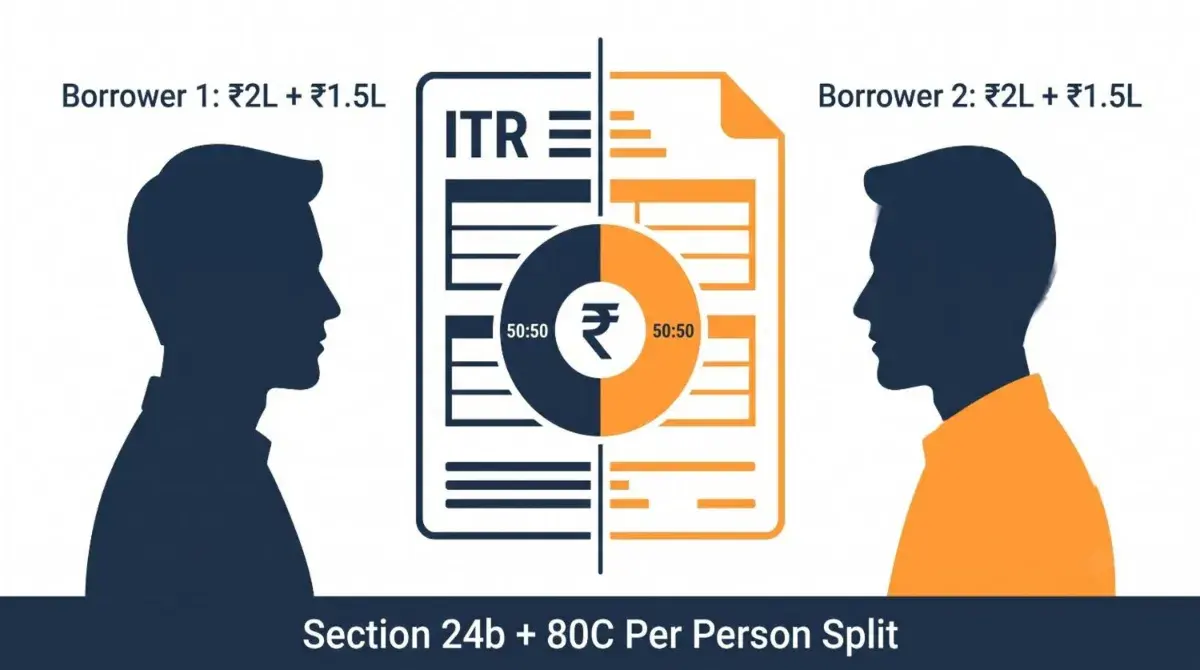

Joint home loan tax benefit split calculator FY 2025-26 shows exact 80C and 24(b) deduction per co-owner, with worked ₹ examples and ratio tips.
A joint home loan lets each co-owner claim up to ₹2,00,000 in interest under Section 24(b) and ₹1,50,000 in principal under Section 80C — separately, on their own ITR. The catch? Your split has to follow your ownership percentage on the property papers, not who transfers more money each month.
When two or more people co-own a house and are co-borrowers on the same loan, each one can claim tax deductions on their own share — instead of just one person claiming the whole thing. That's the joint home loan tax benefit split in a nutshell.
This falls under the Income-tax Act, 1961, since we're talking about FY 2025-26 income, assessed in AY 2026-27. Interest sits in Section 24(b); principal sits in Section 80C. From Tax Year 2026-27 onward, the Income-tax Act, 2025 takes over, and the same benefit shifts to Section 22(2) for interest and Section 123 for principal. The caps stay exactly the same — only the section numbers change.
Here's what most guides don't tell you: the split isn't automatic. You have to work it out yourself, apply the caps to each person separately, and get it right before you file.
Applies to | Does NOT apply to |
|---|---|
Co-owners who are also co-borrowers on the loan | Someone who's a co-borrower but not named on the sale deed |
Spouses, parent-child, or sibling co-owners repaying jointly | An owner who never signed the loan agreement |
Self-occupied or rented joint property | Under-construction property, until possession or completion |
Anyone comparing old vs new regime for a joint loan | New regime filers claiming interest on a self-occupied home — not allowed at all |
One partial case worth flagging: if both of you own the house but only one of you signed the loan papers, only the loan-signer can claim. Ownership on its own isn't enough — you need co-borrower status too, and that's a common trap for co-applicant home loan tax deduction cases where the "extra" applicant was added purely to boost eligibility.
Here are the real numbers — not a description of them.
Deduction | Section (1961 Act) | Section (2025 Act, from TY 2026-27) | Cap per co-owner | Regime |
|---|---|---|---|---|
Interest — self-occupied | 24(b) | 22(2) | ₹2,00,000/year | Old regime only |
Interest — let-out (rented) | 24(b) | 22(2) | No cap; loss set-off against other income capped at ₹2,00,000/year | Old regime only |
Principal | 80C | 123 | ₹1,50,000/year, shared with PPF, ELSS, insurance, etc. | Old regime only |
First-time buyer add-on (loan sanctioned 1 Apr 2016–31 Mar 2017) | 80EE — ₹50,000 | ~130 | Loan ≤ ₹35 lakh, property value ≤ ₹50 lakh | Old regime only |
First-time buyer add-on, affordable housing (loan sanctioned 1 Apr 2019–31 Mar 2022) | 80EEA — ₹1,50,000 | ~131 | Stamp duty value ≤ ₹45 lakh | Old regime only |
[Source: incometaxindia.gov.in]
Both 80EE and 80EEA are closed for fresh loans today — their sanction windows shut years ago. You can only use them if you're still repaying a loan actually sanctioned inside those dates. And each co-borrower's first-time-buyer status is checked separately, so one of you might qualify while the other doesn't.
Pre-construction interest isn't lost either. Add up everything you paid before possession, divide by five, and claim that instalment every year for five years starting from the year construction finishes — still inside the ₹2,00,000 self-occupied cap. [Source: incometaxindia.gov.in]
Numbers convince better than explanations. Here are two, worked out step by step.
Suresh and Priya, both salaried, co-own a self-occupied flat 60:40 (Suresh's favour), and both are named co-borrowers. In FY 2025-26 they paid ₹3,80,000 in interest and ₹1,60,000 in principal. Suresh is in the 30% slab, Priya in the 20% slab, both on the old regime.
Interest split:
Suresh: ₹3,80,000 × 60% = ₹2,28,000 → capped at ₹2,00,000
Priya: ₹3,80,000 × 40% = ₹1,52,000 (under the cap, so the full amount counts)
Principal split:
Suresh: ₹1,60,000 × 60% = ₹96,000
Priya: ₹1,60,000 × 40% = ₹64,000
Tax saved (deduction × slab rate × 1.04 for cess):
Suresh: (₹2,00,000 + ₹96,000) × 30% × 1.04 ≈ ₹92,352
Priya: (₹1,52,000 + ₹64,000) × 20% × 1.04 ≈ ₹44,928
Combined household saving: roughly ₹1,37,280
Notice something? ₹28,000 of Suresh's interest share goes to waste because his 60% cut crosses the cap. That's exactly why the ownership ratio matters — it's not just paperwork, it decides how much of your own money you actually get back.
Ramesh and his wife Farida co-own a self-occupied flat 50:50. Farida is a homemaker with no taxable income. Total interest paid: ₹4,00,000. Total principal: ₹1,20,000.
At a 50:50 split:
Ramesh: interest ₹2,00,000 (capped), principal ₹60,000 — both fully usable, he's in the 30% slab
Farida: interest ₹2,00,000, principal ₹60,000 — worth zero in tax, since she has no income to set it against
Ramesh's usable deduction: ₹2,60,000. Tax saved ≈ ₹2,60,000 × 30% × 1.04 ≈ ₹81,120.
Now compare an 80:20 split in Ramesh's favour:
Interest doesn't change — his 80% share (₹3,20,000) still hits the same ₹2,00,000 cap
Principal: Ramesh's share becomes ₹1,20,000 × 80% = ₹96,000, up from ₹60,000
That extra ₹36,000 of usable principal saves Ramesh about ₹11,232 more — money the family was quietly losing at the flat 50:50 split. This is the whole idea behind an optimal ownership ratio for a joint home loan: match the share to who can actually use the deduction, not just to who "sounds fair" on paper. Want to test your own numbers instead of doing this by hand? The Joint Home Loan Tax Benefit Split Calculator runs exactly this math for you.
No portal is involved here — this is arithmetic you do once a year, right before you file.
Get your annual interest certificate from your lender. It separates interest paid from principal paid.
Check your ownership percentage from the sale deed or co-ownership agreement — this is what actually decides your split.
Multiply total interest by your ownership share. Cap it at ₹2,00,000 if the house is self-occupied.
Multiply total principal by your ownership share. Cap it at ₹1,50,000, combined with any other Section 80C investments you already hold.
Do the same for your co-owner, then add both figures to see your household total.
If one of you sits in a higher slab, or one of you has little taxable income, try a different ownership ratio and see which split actually saves the family more — within what your ownership documents allow, of course.
The formula, in one line:
Interest per person = min(Total interest × ownership %, ₹2,00,000 for self-occupied; no cap if let out) Principal per person = min(Total principal × ownership %, ₹1,50,000)
You claimed by EMI share instead of ownership share. The law follows the ownership ratio on your registered documents, not who paid more of the EMI each month. If you've been claiming the wrong split, file a revised return under Section 139(5) before the deadline and redo the math using your actual ownership percentage.
You missed the co-borrower condition. If you're an owner but never signed as a borrower, and you've been claiming a deduction anyway, that claim gets disallowed the moment it's scrutinised. Fix it going forward by getting added as a co-borrower with your lender, or let the actual sole borrower claim the full amount instead.
Your interest certificate doesn't split the figures. Some lenders issue one combined certificate for a joint loan, which makes filing separately a headache. Write to the bank's home loan servicing desk and ask for a split certificate showing each borrower's share — most banks turn this around within 7 to 10 working days.
Document | Digital copy accepted? | Where to get it |
|---|---|---|
Home loan interest certificate | Yes | Lender's net banking portal |
Registered sale deed showing ownership % | Yes, scanned copy | Sub-registrar office or builder |
Loan agreement listing all co-borrowers | Yes | Lender |
Possession or completion certificate | Yes | Builder or municipal authority |
PAN of each co-owner | Yes | Already with you |
Bank statements showing EMI debits | Yes | Net banking — only needed if the interest certificate doesn't split figures |
Claiming a deduction you're not entitled to — splitting by EMI ratio instead of ownership, say, or claiming without co-borrower status — counts as under-reporting income. Under Section 270A of the Income-tax Act, 1961, that draws a penalty equal to 50% of the tax on the under-reported amount, rising to 200% if it's treated as deliberate misreporting. [Source: incometaxindia.gov.in] On top of that, any resulting tax shortfall attracts interest under Sections 234B and 234C for however long it stayed unpaid.
Note: the Income-tax Act, 2025 is understood to carry this provision forward under a renumbered section for returns filed from Tax Year 2026-27 onward. We'd recommend confirming the exact new section number with your CA or against the notified Act text before relying on it for a Tax Year 2026-27 filing.
Yes, if both are registered co-owners and co-borrowers. Each can claim up to ₹2,00,000 on their proportional share of interest, which means the household can reach ₹4,00,000 combined for a self-occupied property — one of the most common home loan tax benefit husband wife calculator questions we see.
No. The deduction follows the ownership percentage stated in your property documents, not the EMI contribution ratio. A lot of people assume it works the other way — it doesn't, and claiming by EMI share risks disallowance if your return gets checked.
No. You need both: registered co-ownership of the property and co-borrower status on the loan. A co-borrower who isn't listed as an owner gets nothing, even if they're paying part of the EMI.
It depends on your slab rates and whether one of you has little or no taxable income. As a rule, giving a bigger share to the higher-slab earner recovers more usable deduction — though once someone's share crosses the ₹2,00,000 interest cap, shifting the ratio further stops making a difference on that side.
Total pre-construction interest gets divided by five, and that yearly instalment is then split between co-owners by ownership share — same rule as current-year interest, still inside the ₹2,00,000 self-occupied cap.
No. Section 24(b) interest on a self-occupied property simply isn't available under the new regime. If one spouse has picked the old regime and the other the new one, only the old-regime spouse can claim interest — worth thinking about when you decide the ownership ratio.
There's no ₹2,00,000 cap on interest for a let-out property — your full proportional share is deductible against the rental income. But if that interest creates a loss, only ₹2,00,000 of that loss per person can be set off against your other income each year; the rest carries forward.
File a revised return under Section 139(5) if you're still within the deadline, and recompute using your actual registered ownership percentage instead of whatever ratio you used before.
Yes, the same rule stretches to more people: each co-owner who's also a co-borrower claims their share of interest (capped at ₹2,00,000 each for a self-occupied home) and principal (capped at ₹1,50,000 each).
No — it's a combined ceiling shared with PPF, ELSS, life insurance premiums, and every other Section 80C investment you hold. If you've already used ₹1,00,000 of that limit elsewhere, only ₹50,000 is left for your home loan principal claim.
Only that person gets the additional deduction. Your co-owner doesn't get it automatically just because you share ownership — eligibility is checked person by person, and both sanction windows are shut for fresh loans in any case.
Pull out your interest certificate, check your ownership percentage on the sale deed, and run both through the Joint Home Loan Tax Benefit Split Calculator — it'll show your exact per-person deduction and combined tax saving in seconds. To see which regime actually saves more once this deduction is factored in, try the Old vs New Tax Regime Calculator. For a full walkthrough of Sections 24(b), 80C, and 80EEA, read our Home Loan Tax Benefits Guide FY 2025-26, and for a deeper dive into the interest deduction itself, see the Section 24(b) Home Loan Tax Guide. If your property is rented rather than self-occupied, the Rental Income Tax Calculator will help you work out the let-out side of things. For the official word on deduction sections, check the Income Tax Department's deductions page.
For educational purposes only. Verify all figures at official sources before acting. Toolisky is not affiliated with any government body. Consult a qualified CA or legal professional before making compliance decisions. See toolisky.com/accuracy-and-limitations.

Border tax payment 2026: pay checkpost tax on Parivahan, fix a pending or failed transaction, verify your receipt, and check state-specific rates.
Aug 31, 2026

Section 87A proviso explained: first proviso rebate limits vs the second proviso's capital-gains bar, with FY 2025-26 math and real fixes for demand notices.
Aug 19, 2026
Section 87A rebate on lottery income is not allowed under Section 115BB, even below ₹12 lakh. See exact FY 2025-26 tax math, rules, and TDS rate details.
Aug 12, 2026